
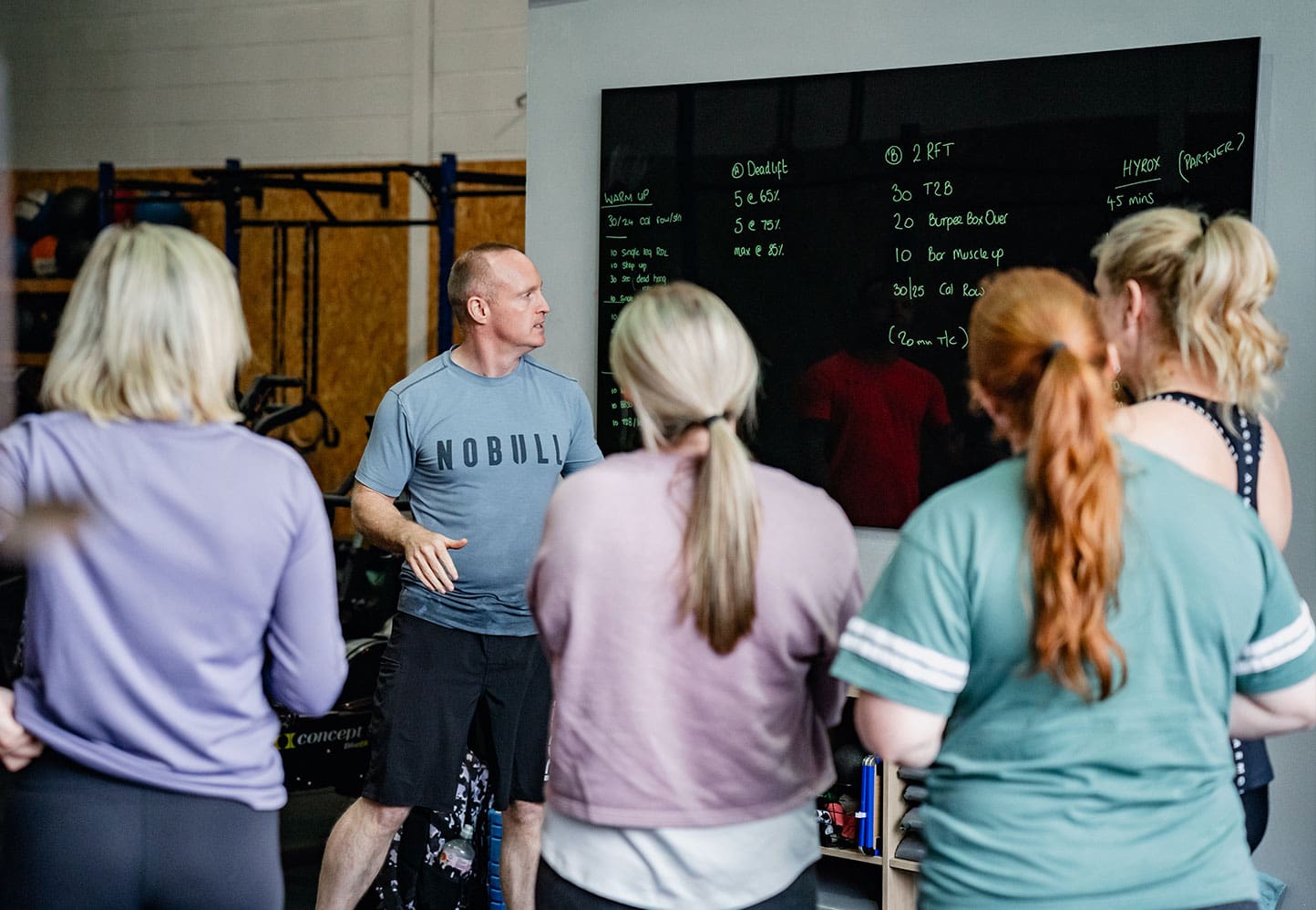
If you’ve ever thought “CrossFit looks great, but I’m not fit enough to start,” this one is for you.
Scaling is one of the most important parts of CrossFit. It’s the reason a complete beginner who has never set foot in a gym can train in the same class as a seasoned athlete and both can leave having had a great workout. At CrossFit Wolfhound Larne, we scale everyone, every session, so the workout meets your needs and moves you towards the results you came here for.
What scaling actually means
Scaling isn’t making a workout “easy”. It’s adjusting the workout so you get the same training effect the coach had in mind, while working safely at your level.
Every workout is written to achieve something specific. It might be a short, fast, lung-burning effort, or a heavier, slower grind. Scaling keeps that goal intact by changing the details to suit you: the weight, the number of reps, the movement itself, or how far you move through it.
Same workout, same stimulus
Take a workout of deadlifts and rowing. The aim is heavy lifting that slows you down. If someone scaled the weight so light that they flew through every rep, they’d miss the point of the session, even though it might feel good. If someone else tried to lift a weight their body isn’t ready for, they’d either grind to a halt or risk getting hurt.
Scaling finds the right weight for you, one that’s challenging, but lets you move well and keep working. The same goes for movements like handstand push-ups. If you’d need a minute’s rest after every rep, the workout stops being the fast, intense effort it was designed to be. So we give you a version you can keep moving with, and you still get the intended effect.
It’s not just about the weight on the bar
People often assume scaling means “lighter weights”. It’s much more than that. We look at:
- Load: the right weight to challenge you without compromising your technique.
- Reps and volume: how much work is appropriate, especially if you’re new or coming back after time away.
- Movement: swapping a movement for a version that trains the same pattern, such as ring rows in place of pull-ups.
- Range of motion: working within the range where you can move well, while building the mobility to open it up over time.
- Complexity: simplifying technical movements until you’re ready to progress.
Your scaling will also change from day to day. How you feel, how you’ve slept, and what you’ve done recently all matter.
Scaling is for everyone
It’s not only for beginners. Athletes who’ve been training for years scale too, when they’re coming back from an injury, returning after a break, or working around a niggle. Having an injury doesn’t mean you can’t train. It means we find the version of the workout that keeps you moving safely.
And for newer members, scaling is how you build the foundations properly. Time spent getting your movement right now is what lets you lift heavier, move faster and progress further down the line.
Why we do it
There are a few reasons:
- Safety comes first. Doing too much, too soon, is how people get hurt.
- Better results. Training at the right intensity for you is what drives progress. Too easy and you won’t improve. Too hard and you can’t move well.
- You belong in the class. When everyone is working at the right level, the whole class finishes around the same time, pushes each other on and shares the same experience.
- A long-term goal. The aim is to build you up so that, over time, you can do workouts as written, if that’s what you want.
What this means for you
When you train at CrossFit Wolfhound Larne, you’ll never be left to work out what to do on your own. Your coaches will help you choose the right weight, the right movements and the right approach for the day, and adjust as you improve.
You don’t need to be fit to start. Come in, tell us where you are, and we’ll build the session around you.
Ready to give it a go? Get in touch with CrossFit Wolfhound Larne and book your first session.
This post draws on ideas from “Scaling CrossFit Workouts” by Jeremy Gordon, CrossFit Journal, October 2015.

